Tanvora conceptRepresentative data
Field service and maintenance / Dispatch workspace and field workflow
Field Service Dispatch
Connect incoming jobs, crew availability, dispatcher approval, and field acknowledgement as plans change.
This is an exploratory product study, not delivered client work. Names and interface content are representative.
01 / Understand
Business context
Job details may arrive by phone or message before being copied into a scheduling sheet.
A dispatcher may need to call around to understand crew availability, skills, and travel constraints.
Changes in the field may reach the office too late to inform the next appointment or customer update.
Product opportunity
Turn fragmented job information into an approved dispatch plan that remains clear to both the office and the field team.
02 / Model
Workflow model
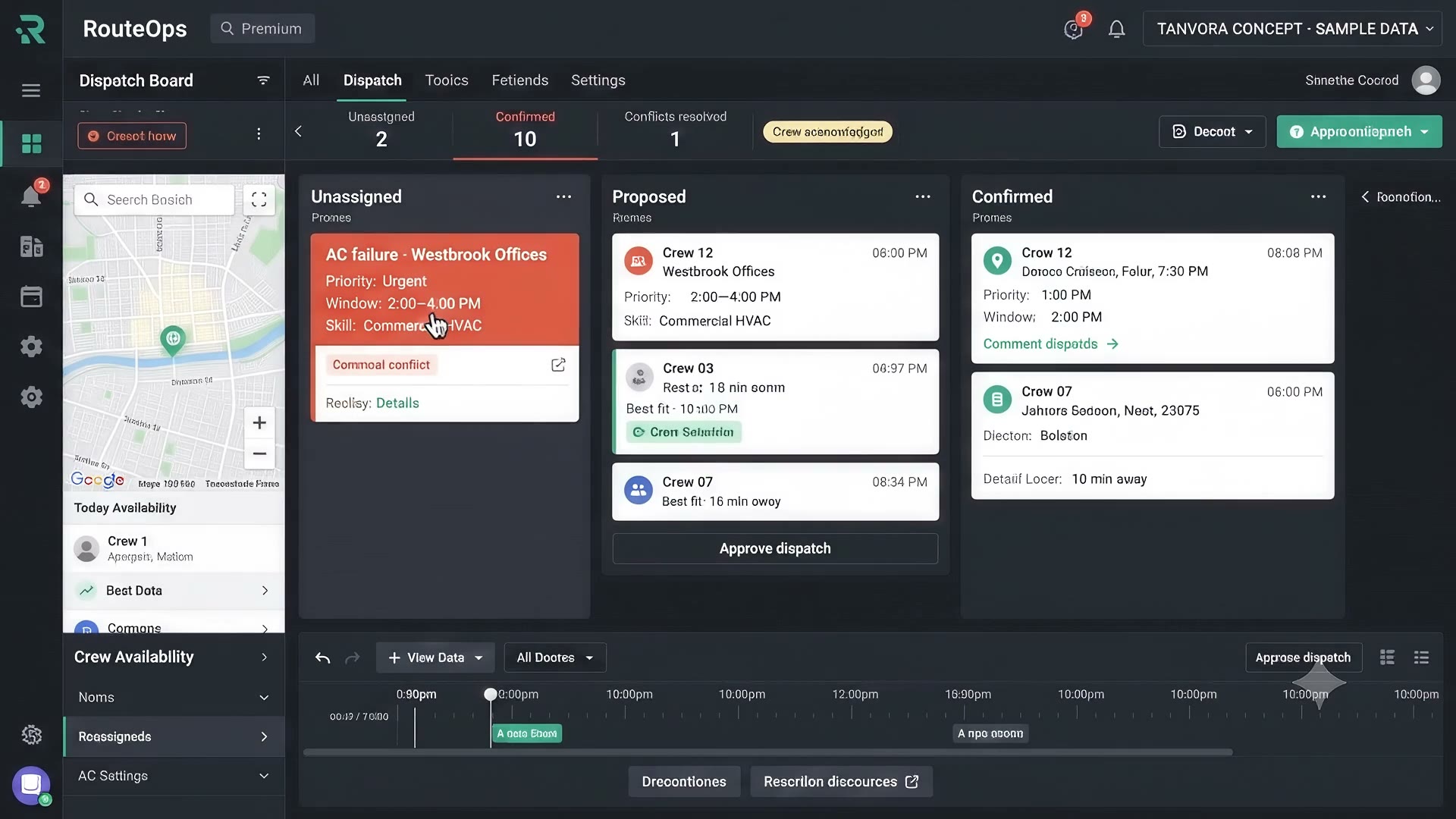
The interface follows an owned sequence from incoming need to reviewed outcome.
A new job enters the dispatch queue with site, timing, and skill requirements.
The system proposes a crew using known availability and travel constraints.
A dispatcher reviews conflicts and approves or changes the assignment.
The assigned crew acknowledges the job and receives the current field brief.
03 / Product film
See the product in motion.
The sequence shows visible actions, review points, and the resulting state.
04 / Decide
Product decisions
Make unassigned work and scheduling conflicts visible before proposing a crew assignment.
Keep the dispatcher in control; a suggested match should remain a proposal until reviewed.
Give the field team a focused job view, with clear acknowledgement and a recovery path for lost connectivity.
Human control
Human approval boundaries
Matching logic proposes an assignment; only a dispatcher can confirm it.
Travel estimates inform planning but do not override local knowledge or safety constraints.
Customer messages are sent only after the operational change has been reviewed.
05 / Connect
Integration boundaries
CRM or job-management system for customer, site, and work-order references.
Maps and routing provider for travel estimates, subject to coverage and service limits.
Messaging and invoicing systems for approved customer updates and reviewed completion handoffs.
Prospective engagement
Production scope
Dispatch constraints, exception paths, and field-role discovery.
Job intake, assignment review, crew acknowledgement, and completion interfaces.
Offline behaviour, integration validation, testing, handover, and support planning.
Bring us the real workflow
Turn the representative model into a product shaped around your operation.
We will validate the roles, boundaries, integrations, and production scope against the way your business actually works.