Tanvora conceptRepresentative data
Professional services / Client portal and engagement workspace
Professional Services Portal
Bring requests, documents, approvals, and progress into one workspace with a clear boundary between client visibility and internal work.
This is an exploratory product study, not delivered client work. Names and interface content are representative.
01 / Understand
Business context
A client request may span an email thread, a document folder, and an internal task list.
Teams may spend time checking which version is current and whether a requested document has arrived.
Clients may need to ask for updates because the next action and its owner are not visible.
Product opportunity
Give clients and delivery teams a shared engagement view while making publication a deliberate, reviewable act.
02 / Model
Workflow model
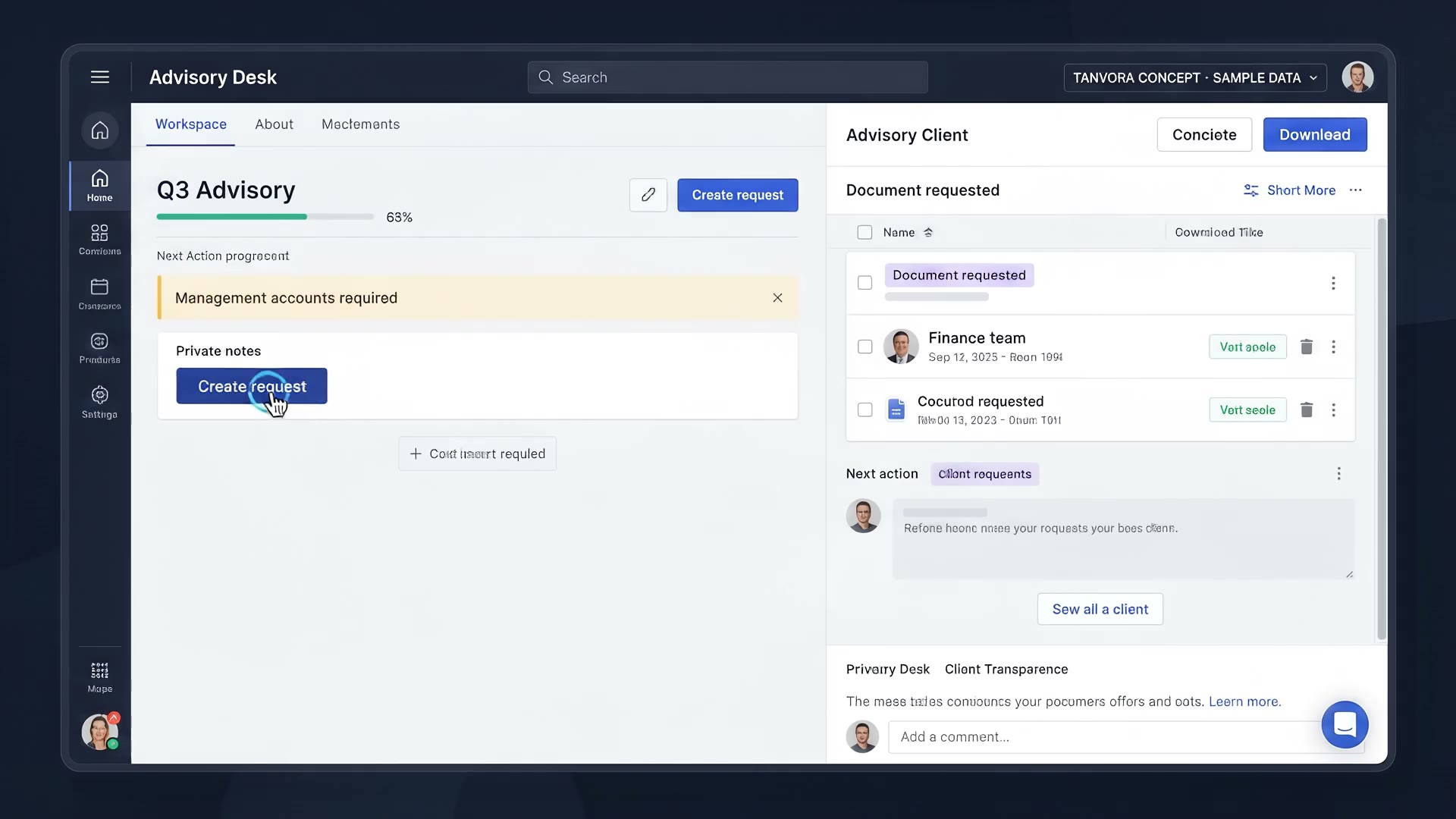
The interface follows an owned sequence from incoming need to reviewed outcome.
A team member opens a structured client request with an owner and due date.
The client uploads the requested material into the engagement workspace.
An internal reviewer checks the document and records an explicit approval decision.
Only approved information is published to the client-facing progress view.
03 / Product film
See the product in motion.
The sequence shows visible actions, review points, and the resulting state.
04 / Decide
Product decisions
Centre the portal on an engagement, with a document checklist and an explicit next action.
Keep internal notes separate from client-facing milestones and require a deliberate publishing step.
Track document versions and review states without treating an upload as an approval.
Human control
Human approval boundaries
Uploaded material remains pending until a named reviewer approves it.
Internal notes and draft milestones never appear in the client view by default.
Publishing is explicit, attributable, and reversible by an authorised team member.
05 / Connect
Integration boundaries
Document storage with scoped access, version references, and agreed retention rules.
CRM or practice-management system for engagement ownership and approved status changes.
Email and signing services for invitations, reminders, and signature status where supported.
Prospective engagement
Production scope
Engagement, role, permission, and publishing-boundary definition.
Client requests, document review, approvals, and progress interfaces.
Integration validation, migration planning, testing, handover, and support planning.
Bring us the real workflow
Turn the representative model into a product shaped around your operation.
We will validate the roles, boundaries, integrations, and production scope against the way your business actually works.